BioPropello™ The world's first standardized olive-polyphenol signaling platform designed to improve crop resilience before stress occurs.
Powered by OliSignal™, Veos's proprietary olive polyphenol signaling technology. BioPropello™ primes crop defense and growth pathways so plants stay productive under heat, drought, and salinity. First-in-class category. Circular, olive-derived, field-validated across four climate zones.
Parsley cycle: d = 7.04, p < 10⁻¹³. Green-bean full cycle: 4.7× yield, 11 days earlier harvest, 100% vs 0% survival under stress. Cereals at Texas A&M: +35% corn, +49% sorghum germination. Stress-protein induction 3×. Chlorophyll retention under 48h stress +23%. Real fields. Real conditions. Four countries.
Climate change is rewriting the productivity ceiling of every major crop.
Heat, drought, and salinity now account for more than half of global crop yield losses. Arable land is degrading faster than it can be restored. Fertilizer overuse is a symptom, not a solution — stressed crops can't absorb inputs efficiently, so growers over-apply, driving costs up, margins down, and emissions higher.
The category has been waiting for an input that addresses the root cause: not more nutrition, but better plant readiness. A crop that is primed to handle stress holds its yield when neighbouring fields fail — and needs less input to do it.
This is not a fertilizer problem. It's a plant physiology problem. BioPropello™ is the first commercial platform engineered to solve it — by priming the crop, not feeding it.
Stress priming is a new category. Not fertilizer. Not seaweed. Not amino acids.
Every input on the market today feeds the plant — supplying nutrients, hormones, or amino acids that the plant would otherwise have to synthesize. BioPropello™, powered by OliSignal™, does something different. Its standardized olive polyphenols are signaling molecules. They don't feed the plant. They tell the plant to prepare — activating stress-response pathways, chaperone proteins, and defense mechanisms before the stress event arrives.
This is the difference between giving someone food and training them to survive a marathon. Both matter. Only the second one keeps them running when the conditions turn.
Fertilizers & NPK products
Supply the plant with elemental nutrients. Necessary but ineffective under stress — stressed plants can't absorb them efficiently, leading to runoff, emissions, and cost inflation.
BioPropello™ · Powered by OliSignal™
Do not feed the plant. Signal the plant to activate its own defense and growth pathways — HSP induction, chlorophyll protection, microbiome activation, seed defense. The plant becomes resilient. Yield holds under stress.
Seaweed extracts, amino acids, humic acids
Provide bioactive nutrition and marginal growth support. No published stress-tolerance evidence. Effective in good conditions; unclear in stress. The category BioPropello is displacing.
Only BioPropello™ sits in the Primer category, because only BioPropello™ is powered by OliSignal™. Every other input on the market is either a Feeder or a Nutritional. That's why the evidence profile — stress proteins, chlorophyll retention, survival under stress — looks different from anything else in the field.
Four pathways. One OliSignal™ application. Convergent resilience.
BioPropello™, powered by OliSignal™, acts on four mechanistically distinct axes that together explain performance across cereals, legumes, and horticulture — under normal and stressed conditions. It primes stress-response proteins, maintains photosynthesis when the plant would otherwise shut down, activates the soil microbiome, and shields germinating seeds from pathogens.
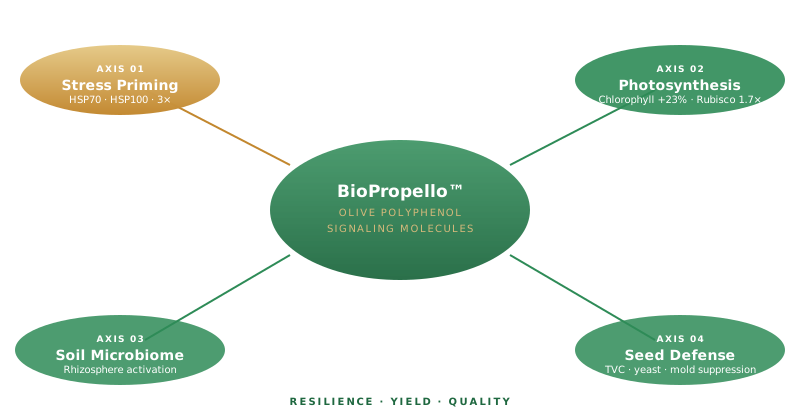
Stress-Protein Priming
Induces heat-shock proteins HSP70 and HSP100 by approximately 3×. HSPs are the cell's molecular chaperones — they refold proteins damaged by heat, drought, and osmotic stress. Priming them before the stress event arrives is what separates surviving from failing crops. This is the mechanism no competing biostimulant category can claim.
Rubisco — the CO&sub2;-fixation enzyme — is simultaneously upregulated ~1.7× at the optimal dose, preserving photosynthetic capacity under stress. Seed total protein expression rises ~4× at the optimal dose; leaf protein ~2× sustained at 16 hours.
Photosynthesis Maintained Under Stress
Protects chlorophyll pigments and sustains photosynthetic activity when the plant would otherwise shut down. Under stress, chloroplasts are the first structure to collapse — reducing carbon capture and starting the yield-loss cascade.
Quantified in the 48-hour alcohol-stress assay: chlorophyll loss reduced by 23% versus untreated controls (tomato model), with +6% greenness retained at endpoint. The maintained-photosynthesis signal is why yield holds when other fields brown out.
Soil Microbiome & Root-Zone Resilience
Activates the beneficial soil microbes that drive nutrient cycling and soil structure. A resilient root zone doesn't just improve nutrient uptake — it stabilises moisture retention and improves resistance to salinity and abiotic stress at the source.
The combination of microbial activation with the stress-protein and photosynthesis effects explains why field performance holds across variable soil conditions, climate bands, and seasons — not just under ideal greenhouse setups.
Seed Defense & Clean Emergence
Suppresses harmful pathogens on germinating seeds and maintains a cleaner rhizosphere. Reduces total viable count, yeast, and mold contamination on seeds. Suppresses S. aureus contamination on plates.
Delivers cleaner, more uniform stands without chemical fungicides — a dual-action platform (growth priming + pathogen suppression) that no single biostimulant or seed-coating competitor matches. This closes the first vulnerability window in the crop's lifecycle.
Cycles completed. Statistical significance most competitors never reach.
BioPropello's evidence base isn't a collection of one-off field trials. It's two completed cycles at commercial-relevance scale, cereal validation from a Tier-1 US agricultural research institution, and a live Cycle 2 currently accumulating data. Every claim on this page traces back to primary data with named collaborators and reported p-values.
Parsley proof-of-concept
Cohen's d of 7.04 is extraordinarily rare in agricultural science — most published field trials report d between 0.5 and 2. Publication-quality technical report produced; JSSAS manuscript in active peer review. Data shared with Agri Connect.
Legume full-cycle validation
The green-bean full cycle is the platform's strongest single validation for climate resilience + productivity in combination: emergence time halved (5 vs 10 days, p = 0.0079), first flowering 5 days earlier, and 100% vs 0% survival in the stress arm. Plant height +8.8 cm @ D26 (p < 0.05).
Corn, sorghum, and rice
Tier-1 US agricultural research institution. Rice early growth days 1–3: +0.95 cm tube (p < 0.001). Rice culm length @ D28: 53.6 vs 28.2 cm (p < 0.001). Confirms mechanism is not crop-family-specific.
Cycle 2 in progress
Cycle 2 tests butterhead lettuce, snow pea, sugar pea, and a strawberry sub-trial. Early emergence: 80 treated seedlings vs 0 in control by Day 4 in butterhead lettuce. Snow pea, sugar pea, and strawberry cohorts accumulating. Updates continuous through cycle end.
The full evidence base — every axis, every readout
Consolidated data across all completed cycles, cereal validation, and supporting lab studies. Each row traces back to a named collaborator with reported statistics.
| Axis | Endpoint | Result vs control | Significance |
|---|---|---|---|
| Stress priming | HSP70 / HSP100 upregulation | ~3× upregulated | Stress resilience |
| Stress priming | Rubisco (CO&sub2; fixation) | ~1.7× upregulated | Photosynthetic |
| Photosynthesis | Chlorophyll retention (tomato, 48h) | +23% · +6% greenness | Under stress |
| Stress survival | Green bean D40 survival | 100% vs 0% | Stress trial arm |
| Full cycle | Parsley biomass (Cycle 1 POC) | Cohen's d = 7.04 | p < 10⁻¹³ |
| Full cycle | Green bean count per plant | 4.7× vs control | +189% length, p = 0.0087 |
| Phenology | Green bean first flowering / first yield | 5d earlier flower · 11d earlier yield | n = 10–11 per arm |
| Emergence | Green bean emergence time | 5 vs 10 days | U = 0, p = 0.0079 |
| Germination | Maize germination rate | 68.7% vs 33.8% | p = 0.0077 |
| Germination | Sorghum germination rate | 77.4% vs 28.6% | p < 0.0001 |
| Growth | Rice culm length @ D28 | 53.6 vs 28.2 cm (+90%) | p < 0.001 |
| Protein | Seed total protein · leaf @ 16h | ~4× seed · ~2× leaf | Optimal: 3–6% |
| Antimicrobial | TVC, yeast, mold on seeds | Reduced vs control | S. aureus suppressed |
| Cycle 2 live | Butterhead lettuce emergence · Day 4 | 80 vs 0 seedlings | FIG-FIELD-2026-BP02 |
Sources: Texas A&M AgriLife Research (cereals); Ferme Innovante Ghassan, Saint-Amand-les-Eaux, France (parsley POC 2024 and green-bean full cycle 2025); Cycle 2 FIG-FIELD-2026-BP02 (in progress, 2026); supporting lab studies for stress-protein, chlorophyll, and antimicrobial endpoints. Technical dossier available under CDA.
One input. Six agricultural systems improved at once.
Every commercial product claims impact. BioPropello's is structural — because the underlying mechanism (stress priming) drives a cascade of downstream effects across resilience, productivity, input dependence, soil health, circularity, and carbon. This is what makes the platform unusual: no single competing input touches all six.
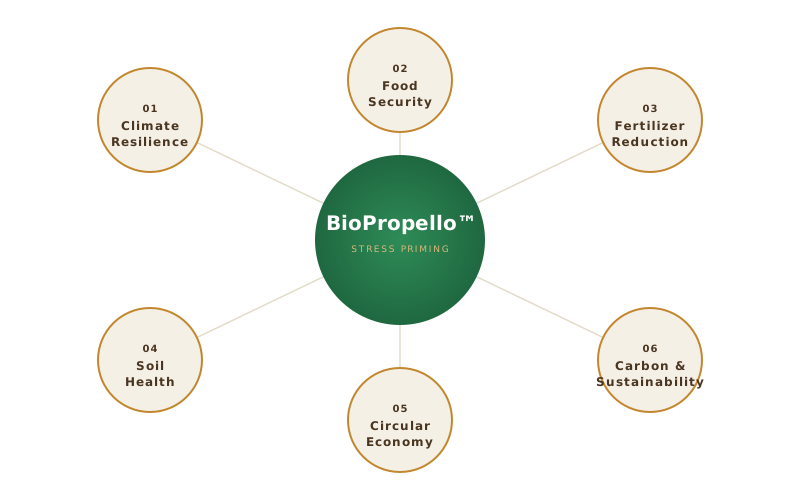
Climate Resilience
BioPropello enables crops to tolerate heat, drought, and salinity by priming their native stress-response systems ahead of the stress event. Heat-shock proteins are the plant's molecular chaperones — inducing them proactively is the difference between surviving and failing under climate volatility.
Food Security
BioPropello maintains or improves yields under increasingly stressful growing conditions. Cereal germination doubles. Legume yield rises up to 4.7×. Rice growth +90%. Parsley biomass ×7.6. In real fields. In real climate zones. Not lab conditions.
Reduced Fertilizer Dependence
Primed plants absorb inputs more efficiently. Field evidence supports ~20% reduction in fertilizer requirement at maintained or improved yield. Reduces input cost, runoff, and downstream N&sub2;O emissions — three problems collapsed into one solution.
Soil Health
BioPropello activates the rhizospheric microbial community — the microbes that drive nutrient cycling, soil structure, and water retention. The antimicrobial axis simultaneously suppresses harmful pathogens on germinating seeds, delivering cleaner emergence and better long-term soil biology.
Circular Economy
BioPropello is 100% olive-derived — turning what was previously a Mediterranean olive-industry by-product into a high-value agricultural input. Every kilogram of BioPropello is a kilogram diverted from waste streams. Circularity isn't a marketing claim here — it's the source of the raw material.
Carbon & Sustainability
Combined effect on inputs (fertilizer reduction), yields (crop-loss reduction), and sourcing (circular olive by-product) delivers a materially reduced environmental footprint per unit of crop produced. Every axis compounds: less fertilizer → less N&sub2;O; stable yields → less land pressure; circular sourcing → lower embodied carbon.
No competing biostimulant, fertilizer, or seed treatment on the market touches all six of these outcomes with one input. That combination is the reason BioPropello is category-defining, not category-competing.
Validated across four climate bands. Mechanism-agnostic to crop family.
Consistent performance across two structurally different crop families — cereals (cool-season monocots, dry-grain harvest) and legumes / green crops (warm-season dicots, fresh harvest) — plus horticulture, across four climate bands, confirms a mechanism that is not crop-specific and not climate-specific. The same dose range (3–6%) applies everywhere.
Cereals
Legumes & Greens
Horticulture
Maize & Staples
Same input. Same dose range. Four climate bands. Two crop families. Every deployment validated. This is how you distinguish a real platform from a product that happens to work in the greenhouse where it was born.
The only entry with stress-tolerance evidence — plus every other advantage.
The European biostimulant market is crowded with seaweed extracts, amino-acid hydrolysates, and botanical blends. None publishes stress-protein data, chlorophyll-retention data, or under-stress survival data. None combines plant-growth priming with pathogen control in a single 100% natural input. None comes from a circular olive-by-product supply chain.
| BioPropello™ | Agrialgae® | Biimore® | Trainer® | Kynetic4® | Fertiactyl Starter | |
|---|---|---|---|---|---|---|
| Category | Stress Primer | Nutritional | Nutritional | Nutritional | Nutritional | Nutritional |
| Source | 100% Olive-derived | Seaweed liquid | Plant-extract liq. | Amino hydrolysate | Botanical extract | Seaweed + humic |
| Stress-protein evidence | HSP70 / HSP100 ↑ 3× | — | — | — | — | — |
| Chlorophyll-retention data | +23% under 48h stress | — | — | — | — | — |
| Under-stress survival | 100% vs 0% D40 | — | — | — | — | — |
| Germination evidence | Corn +35 · Sorghum +49 pp | Vigor claims | Demo emergence | Transplant vigor | Flowering support | Emergence boost |
| Circular sourcing | ✓ | — | — | — | — | — |
| Antimicrobial dual action | ✓ | — | — | — | — | — |
| Cost / ha / season | €100/ha | €66–198 | €184–414 | €162–330 | €51–120 | €256 |
BioPropello is the only entry with quantified stress-tolerance evidence. Every other entrant in the biostimulant category competes on nutrition. That's a different problem, and a different buyer, in a warming climate.
Immediate market access across four key regions.
BioPropello™ qualifies under low-risk regulatory pathways in the United States, the European Union, Canada, and Japan — enabling near-term commercial deployment without lengthy registration cycles, and supporting the accepted-claim set used by distributors across all four geographies.
FIFRA Exempt · Soil Amendment / Plant Inoculant
Plant Biostimulant · CE-marked
Agricultural Supplement · Fast-Track
Ordinary Fertilizer Registration
Accepted claims across jurisdictions
- Enhances soil microbial activity
- Improves nutrient availability and uptake
- Supports seedling establishment
- Promotes abiotic stress tolerance
- Improves soil structure and moisture retention
Compositions and methods for plant priming & seed protection.
BioPropello™ is protected by a patent-pending portfolio in the United States, the European Union, and via the Patent Cooperation Treaty (PCT) — covering both the composition of the olive-derived active matrix and the methods of use for plant stress priming, growth promotion, and seed-borne pathogen suppression.
Patent-Pending Portfolio
- US application — Compositions and methods for plant priming and seed protection
- EU application — Compositions and methods for plant priming and seed protection
- PCT application — International filing covering additional national-phase jurisdictions
- Trademark — BioPropello™
Scope of Protection
- Composition of matter — proprietary olive-derived water-dispersible powder formulation
- Method of use — agronomic application across cereals, legumes, and horticulture at 3–6% dose
- Stress-priming applications — heat, drought, salinity resilience
- Seed protection applications — pathogen suppression and clean emergence
Farmer ROI — the BioPropello™ advantage.
Across a standard 90-day crop cycle with 15 applications, BioPropello™ delivers a 3–5× payback per season under normal conditions. The value compounds in stress years — when competitors' inputs fail and BioPropello holds.
In stress years — drought, heat waves, salinity events — competitor inputs fail. Fertilizer runs off. Yields collapse. BioPropello holds. The stress-year ROI is where the platform value compounds.
Validated across four countries, three continents, four climate zones.
BioPropello™ is in active field deployment with academic, private-farm, and government partners. The four geographies span North America, the Mediterranean, Western Europe, and East Africa — confirming agronomic generalisation across climate bands.
Texas A&M AgriLife Research
Ferme Innovante Ghassan
University of Málaga
Local Government / IRK
Two overlapping TAMs. One platform that sits in both.
BioPropello™ is the first platform to sit in both the biostimulant TAM ($4.5B) and the climate-adaptation agriculture TAM (~$16B) — a combined addressable market of roughly $20 billion, growing at 11.2% CAGR (biostimulants) and 20%+ CAGR (climate adaptation ag) respectively.
Year-5 target: $50M revenue · 500,000 hectares under deployment · 35–40% net margin · 20–25% EBITDA by Year 3. From a $1M revenue baseline with CAGR > 100%.
Direct sales. Licensing. Geographic scale.
Sequential three-phase model: direct sales and seed-company partnerships in the near term; licensing and bulk supply in the mid term; geographic expansion to US, LATAM, and MENA in the long term. Yield-share and royalty models on flagship cereal partnerships.
Direct sales & seed-company partnerships
Direct sales to agribusinesses and distributors; partnerships with seed companies and large-scale farms across the EU and select North American customers.
Licensing & bulk supply
Licensing and bulk supply agreements; cost-effective scalable growth across the EU. Distributor exclusivities by geography and crop category.
Geographic expansion
Expansion into US, LATAM, and MENA; scale revenues to $50M with CAGR > 100% from $1M baseline. Yield-share or royalty models on flagship cereal partnerships.
BioPropello™ is open to strategic deployment.
Veos partners with seed companies, large-scale farm operators, EU and MENA distributors, agricultural cooperatives, and governments building climate-resilient food systems. Contact our team to request the full technical dossier, field-trial data, or licensing-territory discussion.
OliSignal™ and BioPropello™ are trademarks of Veos Pharmaceuticals, S.L. Patent applications pending in the United States, the European Union, and via the Patent Cooperation Treaty (PCT). CE-marked under Regulation (EU) 2019/1009 (fertilising products); FIFRA-exempt under 40 CFR 152.6(g) in the United States. Third-party product names (Agrialgae®, Biimore®, Trainer®, Kynetic4®, Fertiactyl Starter) are trademarks of their respective owners and are referenced for comparative purposes only based on publicly available product documentation.
© 2026 Veos Pharmaceuticals, S.L. — CIF B10704534 · Madrid, Spain.